Rethinking UX for conversational shopping
How e-commerce must evolve from rigid keyword searches to fluid, AI-driven "messy" human dialogue. Drawing from my work at Bloomreach Clarity, I’ve defined five core principles for designing these new retail experiences.

By now, we’ve trained users to expect AI to understand nuance, but then we put them back in the world of rigid search bars on most sites.
You’re looking for a dress for a friend’s summer wedding. You type it into a site’s search bar… and chances are you get lots of irrelevant results. Too formal. Too casual. Not even dresses.
But here’s what’s interesting: if you asked ChatGPT the same question, “help me find a dress for a friend’s summer wedding,” you would get thoughtful follow-ups. What’s the venue like? What’s your style? What’s your budget? The AI would actually converse with you to understand you.
This disconnect isn’t just annoying; it’s becoming a competitive disadvantage. Users now expect AI-level understanding everywhere, but most shopping experiences still operate like it’s 2015. We’re asking people to dumb down their natural language for our systems instead of building systems that speak their language.
The opportunity is massive, but so are the design challenges.
Conversations bring fluid intent and context that traditional ecommerce UX was never designed to handle. How do you design for ambiguous intent? How do you maintain trust when the AI doesn’t know something? How do you balance guidance with discovery? These aren’t small tweaks to search bars, they’re a shift in the foundation of how people shop online.
Designing for conversational shopping means rethinking long-established UX patterns and inventing new ones. Here I’ll share some learnings and principles working on these challenges as a product designer at Bloomreach Clarity.
Why Conversation Is Different
Clicks are precise. Select “Size M,” and you’ll get Size M. Conversations are messy. Ask for “something comfy for a summer wedding,” and it could mean a linen dress, a jumpsuit, or sandals.
Unlike button clicks, conversations demand interpretation, clarification, and context.
Conversations inherit shopping complexity
For decades, we’ve imagined shopping journey more as a funnel: homepage → search → product listing page → product detail page → cart → checkout. But shopping is rarely that neat. Shoppers loop, compare, open multiple tabs, abandon, get distracted, and return later. This “messy middle” isn’t a bug, it’s human behavior.
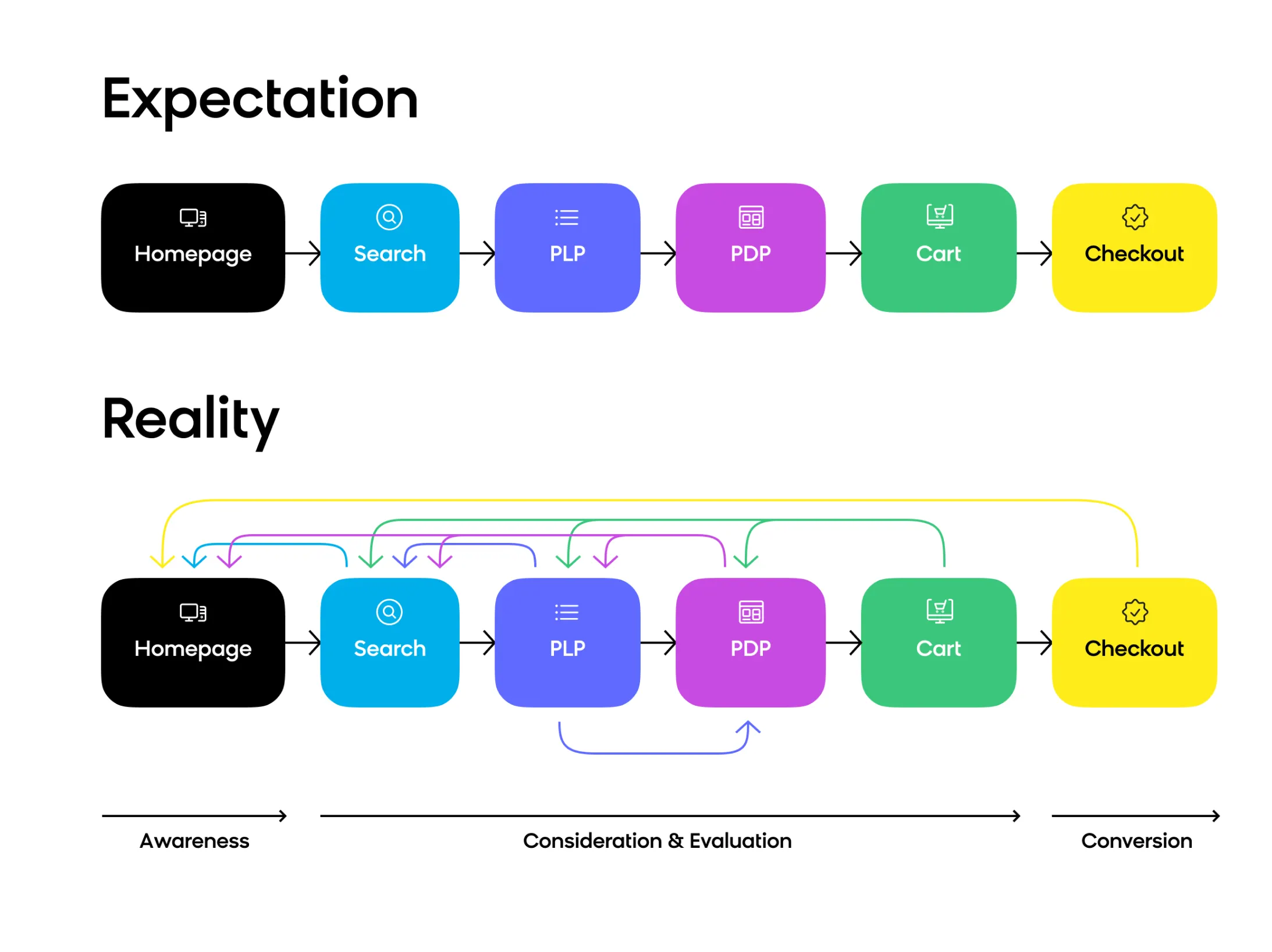
This complexity isn’t new. We’ve always designed tools like filters, breadcrumbs, comparison charts, and wishlists to help shoppers navigate the messy journey. Conversations inherit that same complexity, but with an added layer: a shopper might choose to start chatting on the homepage, on a product detail page, or mid-checkout. The AI assistant must understand not just the words but the moment: where the shopper is, what they’ve done, and what matters now.
Mobile makes this even more challenging. At Bloomreach, we see 75% of conversations with Clarity start on mobile, where users want answers fast, not long back-and-forth exchanges.
That’s why conversational AI isn’t just about natural language, it’s about context and personalization. The guiding heuristics I developed for Clarity are:
Always On → accessible anywhere in the shopping journey
Always Aware → locally relevant to the current step or page
Always Yours → personally adaptive, remembering preferences and history
Only then can a conversation feel like a natural extension of the journey rather than a widget bolted onto the page.
———
Designing for Conversational Shopping
This is still a new territory for UX. There’s no established design system or playbook yet, which means everyone is learning in real time. What I’ll share here aren’t universal laws or polished patterns, but lessons I’ve taken from practice. To make them more useful, I’ve framed them as principles: ways of thinking that have guided my own design decisions and might help others working in this space.

Principle 1: Handle Ambiguity Like an In-Store Associate
Ask a store associate for “something comfy for summer” and they don’t bring 20 random items. They pause and clarify: “Sure, can you tell me more about what you’re looking for? Do you need an outfit for an event? Comfortable shoes for vacation?” They don’t just react, they create a conversation to gather more context.
Most traditional chatbots can’t do this. They’re deterministic and rule-based: either they match your keyword or fail with “Sorry, I don’t understand.” LLM-powered AI assistants are different. Instead of scripting every possible response, you’re setting guardrails for how they should think through ambiguous requests. You want them to know when to ask, when to suggest, and when to step back.
That’s why in Clarity we built consultative selling flows: lightweight clarifying questions before showing results. When someone asks for “summer wedding guest dress,” the assistant might respond: “I can help with that! Are you looking for something more formal for a church ceremony, or casual for a backyard celebration?”
Just as importantly, we also built guardrails around phrases and contexts for conversation engine to steer away from, keeping conversations helpful rather than pushy, and on-brand rather than generic. (You don’t want your AI mentioning competitors in responses, for example.)
The goal isn’t to slow people down, it’s to save them from irrelevant answers that might break trust.
Principle 2: Meet Shoppers Where They Are
A query like “best trail running shoes” signals exploration. “Buy Nike Pegasus 40 in size 9” signals purchase intent. Treating those the same way would be a design failure.
Click-based UX accounts for this with navigation and filters. Conversational UX requires adapting tone, detail, and recommendations to match intent:
Exploration needs breadth: “Here are three popular trail shoes. The Hoka Speedgoat is great for rocky terrain, while the Salomon X-Ultra works better for muddy trails…”
Purchase intent needs efficiency: “The Nike Pegasus 40 in size 9 is in stock. Would you like me to add it to your cart, or do you have questions about fit?”

Conversational design isn’t just about generating responses, it’s about mapping effective conversational responses to shopper’s journey stages and shaping the right interaction for each.
Principle 3: Design for Mobile First
Three out of four conversations with Clarity happen on mobile. That makes mobile not the constraint, but the default.
Designing for mobile is tricky: space is limited, attention is fragmented, and chat competes with product content. Mobile users scroll fast and tap faster.
We tested various mobile conversation form factors: half-sheets, full overlays, and embedded widgets. Half-sheets won for exploration in some AB tests (they don’t cover the entire page), but embedded widgets worked better for quick questions on PDPs. But honestly, I don’t see a clear winner yet. The entire industry is exploring new patterns for conversational commerce on mobile. What remains true across all formats of mobile interactions is this: keep responses short, scannable, and easily actionable.
Principle 4: Optimize for Trust, Not Just Conversion
Classic ecommerce UX optimizes clicks into conversions. Conversational UX needs a different lens: conversations into trust.
Trust is harder to measure (and that deserves its own deep dive). For now, what matters is designing interactions that leave shoppers feeling understood, even when they don’t buy immediately. Trust often shows up in behavioral signals: whether people re-engage, whether they describe the experience as helpful, and whether they return to use the assistant again.
For brands, performance metrics still matter, but they only tell part of the story. Conversion shows success in the moment. Trust shows potential for the future. A shopper who asks about return policies and gets a clear, helpful answer might not buy today, but they’re more likely to come back tomorrow.
As designers, our job is to create experiences where shoppers feel understood. That trust is the foundation on which conversions compound.
Principle 5: Bridge the Familiar with the New
Shoppers don’t magically abandon everything they know when they encounter conversational AI. They still expect visual product cards, familiar navigation patterns, and the ability to browse and filter results.
The best conversational shopping experiences feel familiar to users, even though designing them requires completely new approaches. Shoppers have varying tech fluency and comfort levels with AI. As product builders, we need to accommodate all types of users, from AI enthusiasts to skeptics who just want to find what they’re looking for.
The goal here is progressive enhancement: conversation makes the experience smarter and more personalized, while familiar UI patterns provide the comfort and control users expect. Get this balance wrong, and even the most sophisticated AI feels jarring and foreign.
——
Optimizing for clicks and conversions got us far. But conversations are more human and more fragile. They demand empathy, adaptability, and intentionality in design.
We’re not just designing for checkout anymore. We’re designing for trust. That’s harder, but also more rewarding.
I believe conversational design will reshape ecommerce the way grids, filters, and recommendations once did. The brands and designers who figure this out first won’t just improve conversion rates, they’ll build deeper relationships with shoppers who feel genuinely understood.
The learnings I’ve shared here are just the beginning. As more teams experiment with conversational commerce, we’ll discover new challenges and better solutions together. At Bloomreach Clarity, we’re seeing this evolution firsthand, and I’m excited to share more with you as they emerge.
.other writings